Review the example.org details
Identify domains present in competitor data but absent in yours. Compare the reported example.org, example.edu, example.net with the page or domain you intended to check.
Compare your domain with competitors to find referring sites that link to them. Review the available evidence and build a shortlist of relevant prospects.
Start Backlink gap analysis ↗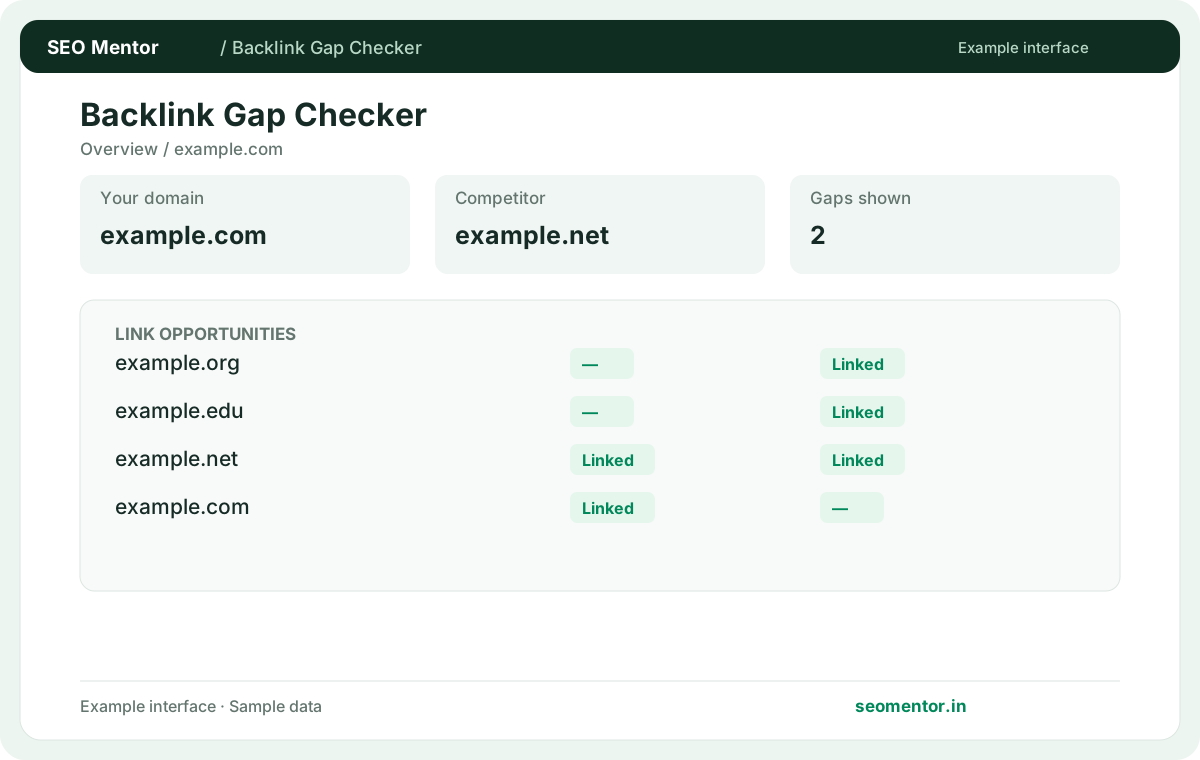
Enter your details and run the free tool to see the results on this page.
Free to use. Results appear on this page.
Focus on editorial relevance rather than copying every competitor backlink. A meaningful comparison starts with relevant domains, not a headline number.
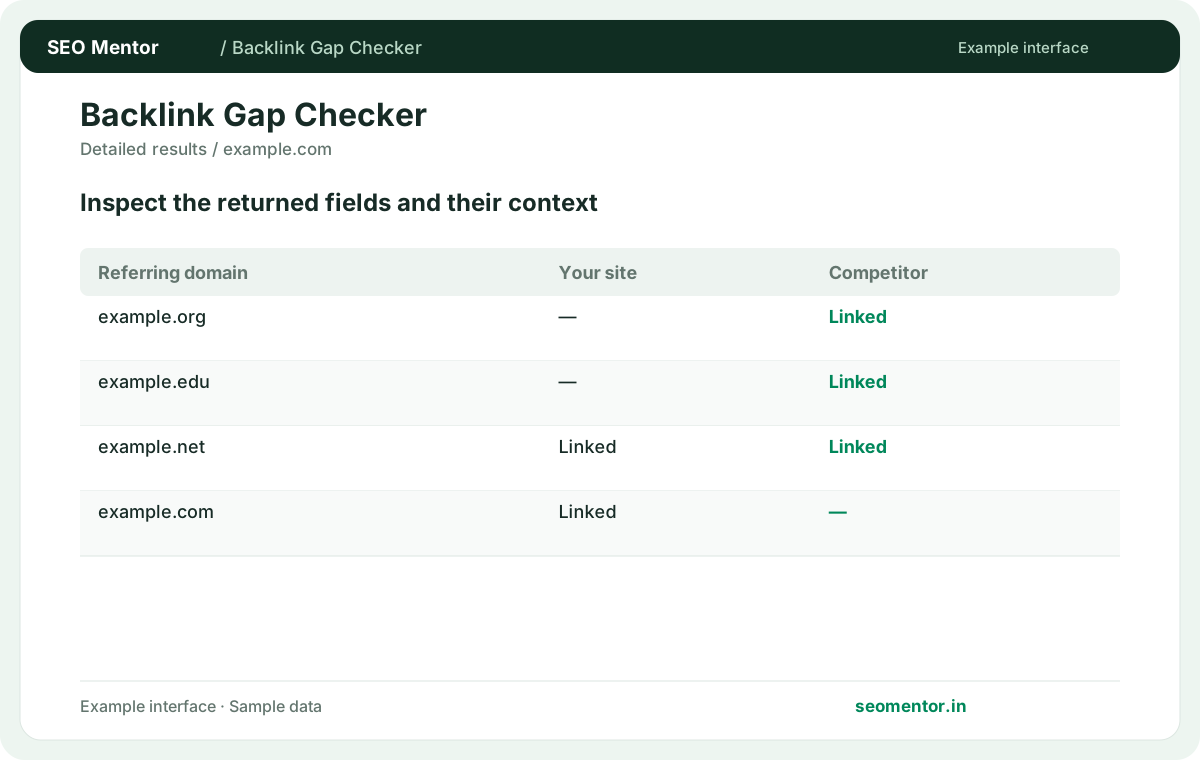
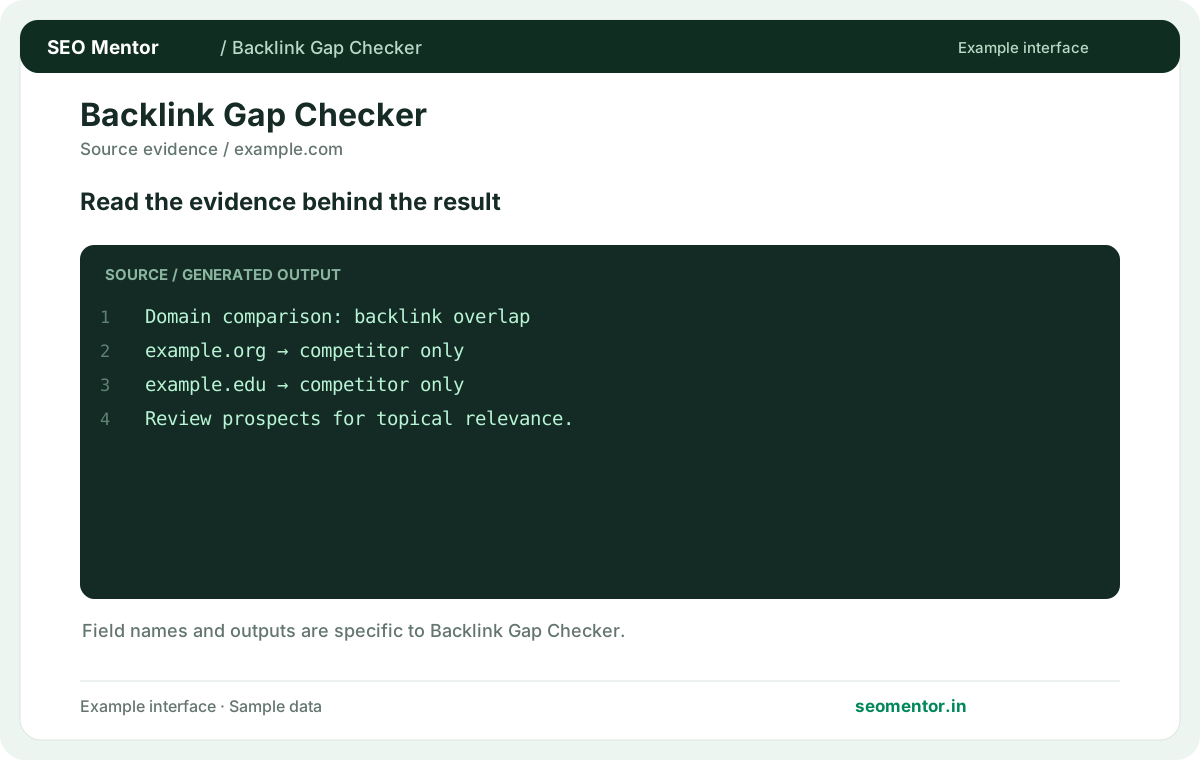
Examine shared domains, competitor-only sources, relevant prospects and other available evidence before making changes.
Record what the report actually shows, review relevant sources, and compare findings with the pages and audiences that matter to your business.
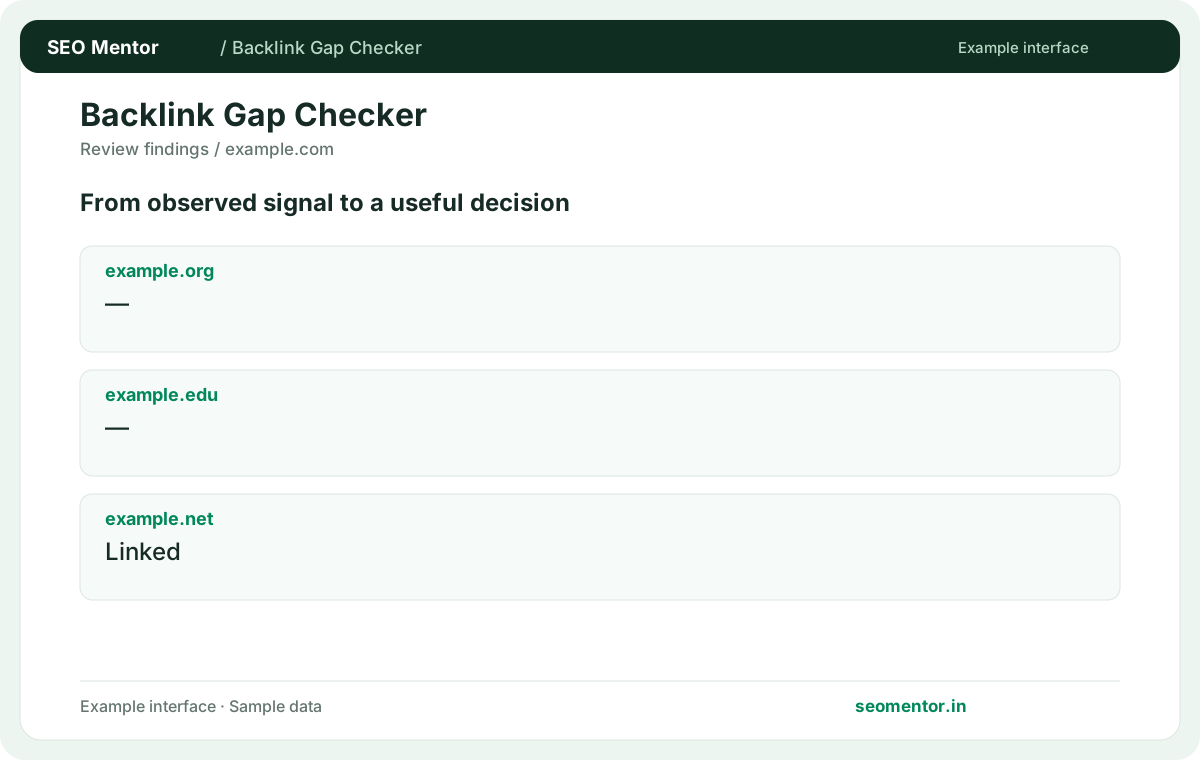
Focus on editorial relevance rather than copying every competitor backlink. Revisit the findings after meaningful changes and avoid interpreting illustrative examples as actual results.
Compare referring-domain coverage for your website and selected competitors. Investigate relevant sources that appear in competitor data before deciding whether they are suitable outreach prospects.
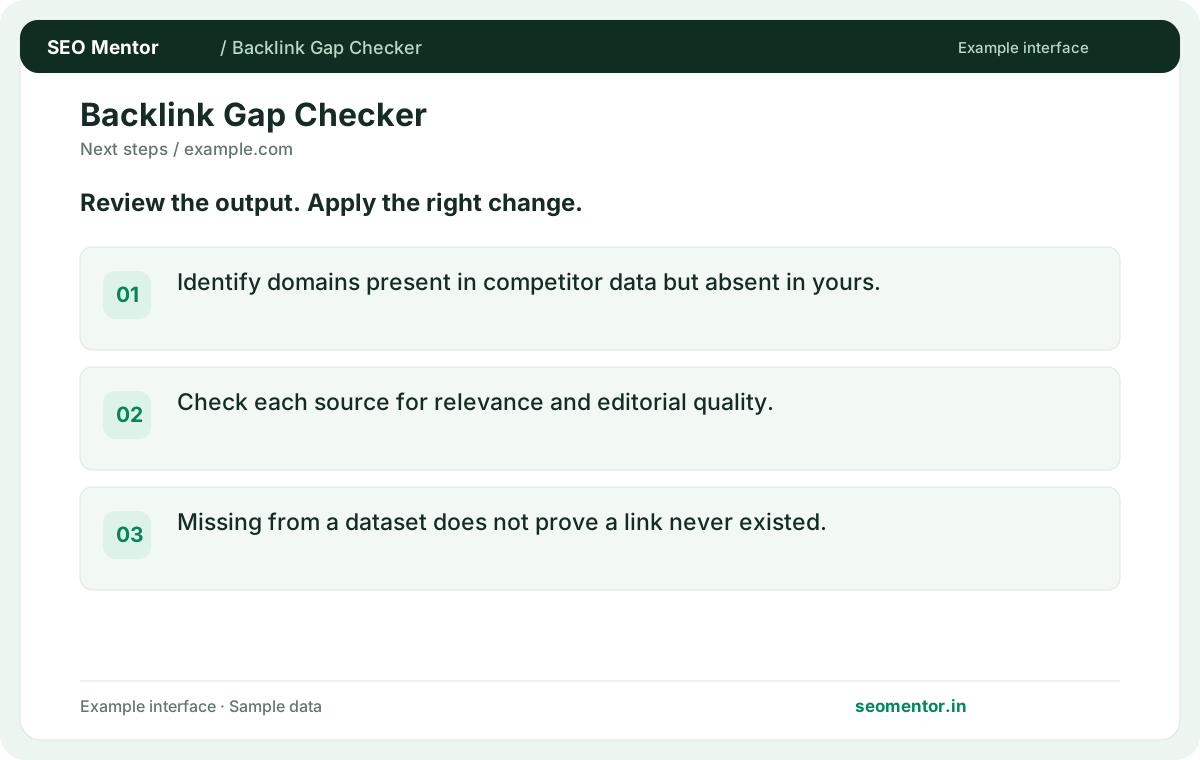
Identify domains present in competitor data but absent in yours. Compare the reported example.org, example.edu, example.net with the page or domain you intended to check.
Check each source for relevance and editorial quality. Missing from a dataset does not prove a link never existed.
Keep the result alongside the page or domain reviewed, so you can compare the evidence after making changes.
Pick sites serving similar audiences with comparable offerings. Their referring sites are more likely to be relevant opportunities.
A regional accounting firm should start with firms serving a similar market instead of a national publication with an unrelated link profile.
It is a source observed linking to a competitor with no corresponding link observed for your site. Provider coverage affects that comparison.
If a source links to two rivals but has no observed link to your domain, open the source page and confirm that your site is genuinely absent.
The page may cite a resource, mention a partner or list an event. Understanding that context tells you whether you have a useful contribution.
A grant listing, guest article and data citation each require different outreach. Read the page before deciding what to propose.
Prioritise relevant editorial sources that serve your audience. Ignore placements that depend on a relationship or product you cannot reasonably replicate.
If the link is a customer case study, a different business cannot reproduce it by sending the same pitch. Look for sources where your own experience would fit.
A source linking to several comparable competitors may cover your category regularly. Review the individual citations before deciding how to approach it.
Check whether the overlapping sources represent distinct publishers or multiple pages from the same directory.
The comparison set expands to include additional sources and overlaps. Keep a stable shortlist when measuring progress.
Save a fixed competitor group for progress tracking, and run additional competitors separately when exploring new leads.
Yes. If several sources link to competitor guides or data, identify what that resource provides and whether your audience needs a better version.
If trade publications cite several competitors' annual pricing reports, read those reports and identify what the publications actually quote. An original benchmark with a clear method and useful data is a better outreach pitch than a generic request for a link.
Check whether the directory has a relevant audience and maintains accurate entries. A correct listing can serve users even if its SEO value is uncertain.
Open the directory and review a few current listings. Check whether it serves your target audience and gives visitors enough information to act.
Start with eligible listings and existing relationships. Put original research, resources and editorial partnerships into a separate work queue.
An association membership listing may need only accurate business details, while a cited benchmark might require original data and a documented method.
Save the source page, linked competitor, context and proposed action. Verify the live link before treating the opportunity as actionable.
Keep evidence of where the link appeared and who it served. Recheck the source before spending time on outreach.
SEO Mentor helps you identify opportunities. SEOKart can help put those findings into action with professional SEO services, technical improvements and ongoing optimisation.
Explore SEOKart SEO Services